
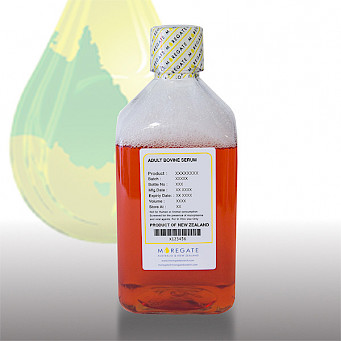
Adult Bovine Serum - Sterile Filtered (ABSF)
Adult Bovine Serum (ABSF) is obtained from blood taken from cattle deemed fit for human consumption following ante and post mortem veterinary inspection. The blood is collected in slaughter-houses supervised by government veterinarians.
ABSF is prepared form Adult Bovine Serum - Raw (ABSR).
STERILE FILTERED: Semi-processed Raw Adult Bovine Serum, is thawed, pooled and filtered through a series of sterile membranes down to 0.2 microns before being finally packaged, usually in 500ml or 1L bottles. No further processing, additions or deletions are performed.
| Available Treatments - Adult Bovine Serum - Sterile Filtered (ABSF) | |
| IRRADIATED | Gamma Irradiation of Sterile Filtered ABSF takes place in Brisbane at an Australian Government licensed gamma irradiation facility. Frozen serum is irradiated following Moregate Biotech's validated procedure to a customer specified dose range. A gamma irradiation indicator (colour change) is applied to every container before irradiation. A Certificate of Irradiation is issued for every lot of irradiated serum. |
| SPECIFICATION - Adult Bovine Serum - Sterile Filtered (ABSF) | |
| Product | Adult Bovine Serum - Sterile Filtered |
| Catalogue No. | ABSF |
| Source | Bovine blood from healthy cattle which have been inspected ante and post mortem by Australian or New Zealand Government veterinarians and passed as fit for human consumption. |
| Collection Method | Serum (ABSR) is passed through a series of filters terminating with 0.2 micron pore size sterilising grade filters. Product is dispensed in ISO 14644 Class 5 Laminar Flow Workstation via a closed system. It is then immediately frozen. |
| Description | A clear amber viscous liquid with a characteristic odour. |
| Pack Size | 500ml & 1000ml sterile PET & PETG square media bottles |
| Storage | -20 degrees Centigrade |
| Expiry Date | Six years from the date of manufacture |
| Test | Method | Specification | |||||||||
| Visual Examination | Visual | Satisfactory | |||||||||
| Viruses | Modified 9CFR (113 - 53c) | ||||||||||
|
|||||||||||
| Sterility | Millipore Steritest Broth Culture 14 Day Incubation | Sterile | |||||||||
| Mycoplasma | Mycoplasma Broth Culture 35 Day Incubation | Not detected | |||||||||
| pH | pH meter | As reported | |||||||||
| Osmolality | Osmometer | 240-320 mOsmol/kg | |||||||||
| Total Protein | Beckman Coulter Synchron Clinical Systems | 45 - 85 mg/ml | |||||||||
| Albumin | Electrophoresis | As reported | |||||||||
| Haemoglobin | Haemoglobin UV/VIS Spectrophotometer | < 4 mg/ml | |||||||||
| Endotoxin | Kinetic Turbidimetric | ≤ 50 IU/mL | |||||||||
| FUNCTIONALITY TEST | ||||||||
| Cell Line Used | ||||||||
|
||||||||
The European Pharmacopeia consists of a number of general and specific monographs covering various classes of products.
The monographs set out requirements to be met and followed for all products in the class.
Recently the EP has introduced a Monograph for Bovine Serum – Monograph No 04/2006:2262 to be found in E.P. 5.4
This monograph provides a definition of Bovine Serum and sets out details of production, and requirements for viral inactivation parameters, quality control testing, storage conditions and labelling.
Moregate Bovine Serum products meet these requirements and Certificates of Analysis are modeled on the QC test requirements.
The United States Pharmacopeia-National Formulary (USP-NF) contains standards for medicines, dosage forms, drug substances, excipients, medical devices, and dietary supplements.
Within the Pharmacopeia are Monographs and general chapters.
The monographs consist of information such as the ingredient name, definition, packaging and labelling requirements, storage and a specification.
The specifications list tests to be performed along with the procedure to be followed and the acceptable limit.
Hazards Identification
- Not hazardous
- Get Medical attention immediately
First Aid Measures
Get Medical attention immediately.
Ingestion
If swallowed, give several glasses of water to drink to dilute.
Skin Contact
Wash skin with soap and copious amounts of water.
Eye Contact
Flush with water for at least 15 minutes, lifting upper and lower eyelids occasionally.
Accidental Release
Procedures for Personal Precaution
Exercise appropriate precautions to minimize direct contact with skin or eyes.
Methods for Cleaning Up
Mop up
Ventilate area and wash spill site after material pickup is complete
Handling and Storage
Handling
Normal measures for preventive fire protection
Storage
Keep tightly closed under correct storage conditions
Exposure Controls / Personal Protection
- Wash thoroughly after handling
- Protective gloves
Disposal Considerations
Contact a licensed professional waste disposal service to dispose of this material.
Transport Information
- Non-hazardous for road transport
- Non-hazardous for sea transport
- Non-hazardous for air transport
Note: The above information is believed to be correct, but shall be used as a guide only.
Disclaimer: For pharmaceutical use only.




PO Box 654
Bulimba QLD 4171, Australia info@moregatebiotech.com Tel: +61 (7) 6473 3997 Fax: +61 (7) 6173 3995